
Address
Studio 03
SUM Studios
1 Hartley Street
Sheffield
S2 3AQ
[email protected]
0114 399 1023
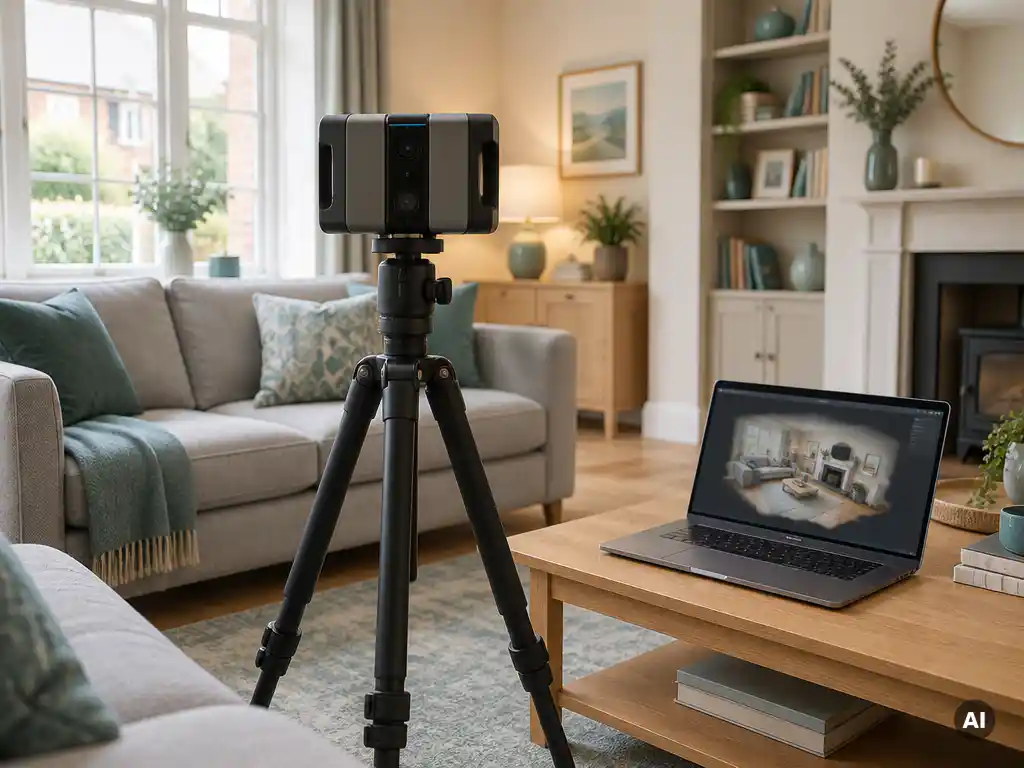
A virtual house tour works by capturing a property with a 3D camera or scanner, processing the images and depth data into a navigable digital model, and publishing it online. Viewers then move through the home room by room from any device, without visiting in person.
The experience feels like standing inside the property because the model preserves real space, not just flat photos. The sections below explain how capture, processing, viewing and pricing fit together.
A property is captured by placing a 3D camera or laser scanner at set points in each room. At every position the device records 360° imagery together with depth data, so the software can later measure the space and stitch the scans into one connected walkthrough.
A typical capture follows a simple sequence:
A standard house usually takes a couple of hours to capture, though larger or more complex properties take longer. Good lighting makes a visible difference to the finished result, so daytime capture on a bright day tends to work best.
After capture, the scan data is uploaded and processed by software that aligns each scan position, blends the imagery and builds a single 3D model. The result is a navigable tour with linked viewpoints, which is then published online and shared through a simple web link.
Processing involves several stages. The software registers the individual scans, meaning it works out precisely where each one sits relative to the others. It then combines the colour images with the depth information to create a coherent model of the whole property.
Many tour platforms also generate a dollhouse view and a floor plan automatically from this data. The finished tour can then be embedded on a property listing, shared in an email or linked from social media.
Editing can include removing the tripod from the floor, correcting colour balance and adding labels to rooms. Professional providers check the result before handover to make sure every room links correctly.
A virtual tour feels 3D because it combines panoramic imagery with depth data. Sensors measure the distance to surfaces in each room, and the software uses those measurements to position viewpoints in real space, so moving between them feels like walking through the home rather than clicking through photos.
Three elements do most of the work:
A basic 360° virtual tour made from stitched panoramas can look immersive, but without depth data it cannot offer accurate dollhouse views or measurements. A true 3D property scan captures the geometry of the space, which is why it supports features such as floor plans and distance measuring.
A virtual tour can be viewed on almost any internet-connected device, including smartphones, tablets, laptops and desktop computers. It opens in a standard web browser from a link, so viewers do not need to download an app or install specialist software.
On a desktop, viewers click and drag to look around and click markers to move between rooms. On a phone or tablet, they swipe and pinch, and some tours let them rotate the device to look around naturally.
Many tours are also compatible with virtual reality headsets for a fully immersive view, although this is optional and most people use a standard screen. Because the tour sits at a web address, it is easy to include in listings, brochures and emails.
The key difference is control. A virtual tour lets viewers choose where to go and what to look at, while a video walkthrough follows a fixed path set by the filmmaker. Viewers of a video can only watch, whereas viewers of a tour can explore.
The two formats suit different purposes:
Buyers and renters often prefer tours because they can spend time on the rooms that matter to them and skip the rest. Video still has a role in conveying mood and neighbourhood context, so some agents use both.
The cost of a virtual house tour depends mainly on the size of the property, the number of rooms, the equipment used and any extras such as floor plans or photography. There is no single fixed price, so providers usually quote per property after learning its size and requirements.
The main factors that influence a quote include:
When comparing quotes for a 3D home tour, check what is included, how long the tour stays online, and whether hosting is part of the price. Asking for examples of previous work also helps you judge the quality before booking.
Scene3D is a UK company that captures properties with 3D scanning equipment and delivers polished virtual tours for homes, apartments and commercial spaces. Its team has worked with estate agents since 2018 and has received over 100 five-star reviews.
To see how it works for your property, explore virtual tours of houses or contact the team for a quote.